Natural Latex Mattress Guide
Dunlop Latex and Organic Mattresses: What the Difference Means for Feel
A mattress can be organic and still feel firm, yielding, springy, or plush. Dunlop describes how latex is made; it does not, on its own, tell you how a finished bed will feel. To understand the experience, look at the whole construction: firmness, thickness, layering, cover, and the surface beneath the mattress.
Shopping for an organic mattress can feel like learning a second language in which familiar words have acquired technical footnotes. “Natural,” “organic,” “Dunlop,” “firm,” and “supportive” appear together on product pages, but they answer different questions. One term may refer to the origin of a material; another to its processing; still another to a laboratory measurement or a shopper’s impression. Put them together without distinction and it is easy to mistake a label for a promise about comfort.
Dunlop latex is a common core material in natural and organic mattresses. Its particular character matters, but it is only one part of the story. A thick, firm latex core beneath a thin quilted cover will not feel the same as a softer, thinner layer surrounded by wool and cotton. Nor will a mattress necessarily feel identical on a flexible slatted base and on a rigid platform. The name of the material is a useful beginning. The construction is what makes the bed.
This guide separates those ideas and offers a practical way to compare natural latex mattresses. Rather than treating “organic” as shorthand for a particular sensation, it looks at the choices that shape feel and support—and the specifications worth checking before a purchase.
What Dunlop means
Dunlop is a process used to turn liquid latex into a resilient foam. In broad terms, latex is whipped into a foam, placed in a mold, heated so it sets, and then washed and dried. The resulting material is used in mattress cores, comfort layers, and pillows. The process name identifies a manufacturing method; it does not establish that the latex is organic, that it is made entirely from rubber-tree latex, or that a mattress has any particular firmness.
That distinction is easy to miss because product descriptions often compress several facts into a few words: “organic Dunlop latex,” for example, combines a process with a claim about material sourcing. To evaluate the claim, check the detailed specification and any relevant certification rather than relying on the adjective alone. A latex mattress may use natural latex, synthetic latex, or a blend. The words “Dunlop latex” by themselves do not resolve which one.
Natural latex begins with sap from the rubber tree, though the finished foam is processed and may contain other ingredients needed for production. A manufacturer’s account of the recipe, sourcing, and certification can clarify what “natural” means for that specific product. Synthetic latex is made using petrochemical feedstocks; blended latex combines natural and synthetic material. These categories speak to composition, not a guaranteed degree of softness or support.
Organic is about standards, not a single feel
Organic claims concern how certified agricultural materials are produced and handled under a particular standard. For latex, a certification such as GOLS may be relevant to organic latex content and processing. Other certifications can address different questions, including testing for certain substances or the conditions attached to textiles. Each standard has its own scope, so it is worth reading what a certificate covers rather than treating a cluster of logos as one all-purpose assurance.
A mattress may also combine latex with organic cotton or wool. Those materials have their own sourcing and certification considerations. A listing that says “organic mattress” should therefore be read layer by layer: What is the latex? What is the cover made from? Are there wool or cotton layers? Which parts are certified, and to what standard? The answers help distinguish a clearly documented product from one relying on broad, unqualified language.
None of this determines whether the mattress will feel right. An organic Dunlop latex core can be made in different firmnesses and thicknesses. A certified organic cover can be quilted with wool or cotton in a way that changes the surface feel. Certification is meaningful information about materials and production, but it is not a comfort rating. It does not tell you that a mattress will be soft, cool, pressure-relieving, or suitable for a particular body.
Why Dunlop latex can feel different from bed to bed
Latex is known for a responsive, buoyant feel: it compresses under load and tends to recover rather than leaving a deep, slow-settling impression. But “responsive” is not synonymous with “firm.” A soft latex layer can compress readily at the surface while a firmer layer beneath it limits how far the body settles. A mattress with a firm core and a generous soft comfort layer may feel quite different from one made of a single firm slab, even if both use Dunlop latex.
People often describe latex as having a springy or lifted sensation, especially in comparison with slow-response memory foam. Those descriptions are useful shorthand, not universal rules. Latex formulation, density, firmness, thickness, cover construction, and the sleeper’s body all influence the impression. A person who finds a mattress buoyant may describe the same bed as resistant; a side sleeper may experience pressure at the shoulder where a back sleeper feels comfortably held.
Some Dunlop latex cores are made with a firmness gradient through the material, sometimes described informally as firmer at one side than another. Manufacturing details vary, and a product page may not provide enough information to establish whether that effect is present or significant in a finished bed. If the manufacturer makes a claim about zoned support or graduated firmness, look for an explanation of how the feature is constructed and whether it is intended to affect the feel in a particular area.
Firmness, thickness, and layering
Firmness is among the most prominent specifications on a mattress listing and among the easiest to misread. Some companies use words such as soft, medium, and firm. Others provide an ILD or IFD figure, a measure of how much force is needed to compress a sample of foam by a specified amount. A higher figure generally indicates greater resistance under that test, but methods and samples may differ. Ratings from separate manufacturers are not always directly comparable.
Even when the rating is clear, it does not translate perfectly into a personal experience. Body weight, shape, sleep position, and preference affect how a surface feels. A lighter sleeper may not compress a firm layer as much as a heavier sleeper does. Side sleepers often need enough surface give for shoulders and hips, while back and stomach sleepers may prefer a surface that resists excessive sinking. These are tendencies, not prescriptions; comfort is individual.
Thickness matters because it determines how much material lies between the sleeper and the support base, but more latex does not automatically mean a better mattress. The arrangement of layers matters as much as their total depth. Consider a design with a medium-firm central core and softer latex on both sides: the core supplies a stable foundation while the outer layers make the first contact more forgiving. A single-layer mattress, by contrast, may have a more direct and uniform feel. Neither construction is inherently right for everyone.
When a mattress has multiple latex layers, ask whether they are bonded, enclosed separately, or designed to be rearranged. Find out whether the top and bottom are identical and whether the mattress can be flipped. A flippable model may distribute wear across two sleeping surfaces, but only if its construction allows it and the manufacturer’s instructions support regular turning. Do not assume that a mattress is reversible simply because it contains latex on both sides.
The layers around the latex
The comfort of a natural rubber mattress is not produced by its core alone. A quilted cover can soften the initial contact, while a taut, minimally padded cover can make the latex’s response more apparent. Cotton, wool, and other fibers may contribute to the way the surface breathes and manages moisture. The thickness and arrangement of those fibers can also affect how readily the sleeper feels the underlying foam.
Wool is sometimes included in mattress quilting or wrapping. It can add a cushioned layer and is valued for its ability to manage moisture; in some constructions, it also forms part of the approach to meeting fire-safety requirements. The exact role depends on the design and applicable regulations. Cotton covers, meanwhile, may vary in weave and stretch. A more elastic knit can move with the latex, while a less stretchy fabric may make the surface feel more contained. These are construction details worth asking about when comparing beds that otherwise seem similar.
There is no need to infer performance from a fiber name alone. Ask how thick each layer is, whether it is quilted or loose, whether the cover can be removed, and what the care instructions permit. A cover that cannot be removed should not be treated like washable bedding. A mattress protector can help keep the surface clean, but the protector itself can change the feel—particularly if it is thick, tightly fitted, or not very breathable.
The bed base changes the result
A mattress does not meet the body in isolation. Its foundation influences how its materials flex and how stable the sleeping surface feels. Slatted bases may provide a degree of give, depending on slat spacing, frame construction, and any center support. A solid platform is more rigid. An adjustable base introduces movement and must be compatible with the mattress’s design and warranty requirements.
Latex itself can remain responsive on a firm platform, but the overall sensation may be firmer than it is on a more flexible foundation. This is one reason that testing a mattress in a showroom does not always reproduce the experience at home. Before buying, check the manufacturer’s requirements for the base, including slat spacing and support across the center. A mattress placed on an unsuitable foundation may not perform as intended and could be excluded from warranty coverage.
Also consider the height of the finished bed. A relatively thin latex mattress on a tall foundation may feel quite different to get in and out of than a deep mattress on a low platform, even if the sleeping surface itself is similar. Bed height, edge construction, and the use of a topper can all affect day-to-day comfort without changing the material at the center.
How to compare product specifications
When two product descriptions both say “natural Dunlop latex,” look beyond the headline. The following details help make the comparison more concrete:
- Composition: Is the latex described as natural, synthetic, or blended? Does the listing state the proportion or provide an appropriate certification?
- Core construction: Is the mattress one piece of latex or several layers? Are firmness levels different from layer to layer?
- Firmness information: Is there a stated rating, an ILD or IFD value, or a clear description of how the firmness was assessed?
- Thickness: How thick is the latex core, and how much additional height comes from quilting, wool, or other materials?
- Cover and comfort layers: What fibers are used, how are they arranged, and can the cover be removed or washed?
- Certifications: Which material or process does each certificate cover? Can the manufacturer provide details about the certified product?
- Foundation requirements: What kind of platform, slats, or adjustable base is allowed?
- Care and warranty: Can the mattress be flipped or rotated? What cleaning methods are permitted, and what conditions apply to the warranty?
- Trial and return terms: How long is the evaluation period, what fees or pickup conditions apply, and are there limits on the mattress’s condition?
A precise comparison is more useful than a contest of adjectives. “Firm, supportive, natural, and breathable” may sound reassuring, but these words do not reveal whether the mattress has one layer or three, whether the cover is removable, or what firmness rating the manufacturer uses. The more specific the construction information, the more responsibly you can judge whether the design fits your needs.
A construction example: a layered latex mattress
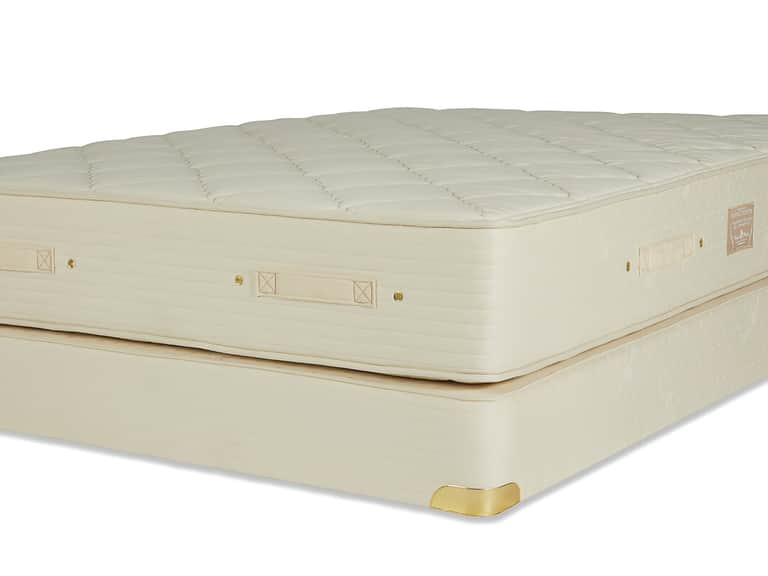
One way to see how layers shape feel is to consider a mattress built around a 10-inch natural latex core. A product description for the Royal-Pedic Premier Natural Latex Quilt-Top Mattress specifies six inches of medium latex in the center, with two inches of softer latex on each side. Wool layers are quilted into a cotton outer fabric, and the design is described as identical on the top and underside, allowing the mattress to be flipped.
That description offers more useful information than a general label alone. The central section and softer outer layers suggest a construction intended to combine underlying support with a more yielding surface. Wool and cotton add further material layers between the sleeper and the latex. The mattress’s flippable design is another practical feature, though its suitability will still depend on personal preference, the bed base, and the manufacturer’s care instructions.
This example is not a universal template for an organic mattress, and the exact feeling cannot be established from specifications alone. “Softer” and “medium” are terms within the product’s own description; they should not be treated as directly equivalent to another company’s ratings. The point is that layer thickness, order, cover, and reversibility give a shopper more to evaluate than “Dunlop” by itself.
Questions of temperature, movement, and durability
Latex mattresses are often selected by shoppers looking for a resilient surface and a material construction different from conventional synthetic foam. Airflow through the core, cover fabric, room conditions, bedding, and individual heat regulation all contribute to perceived temperature. Perforations or channels may help air move through a latex component, but no single construction feature guarantees that every sleeper will feel cool. A dense protector or heavy bedding can make more difference than a product description suggests.
Latex’s springy response may also make movement across the surface feel easier than on some slow-response foams. But motion transfer depends on the full mattress design and the movements of the people sharing it. If one partner is particularly sensitive to disturbance, a return policy that permits a realistic at-home trial may be more informative than a general claim about motion isolation.
Durability is likewise tied to more than the word “latex.” Material quality, foam formulation, total thickness, construction, use, foundation support, and care all matter. Latex can be resilient, but resilience does not make a mattress immune to wear. Review the warranty’s terms and distinguish manufacturing defects from ordinary changes in comfort or surface appearance. A warranty is a document about coverage, not a guarantee that a bed will feel unchanged for a specified number of years.
A practical way to choose firmness
Begin with the position in which you sleep most often, then think about what you want the mattress to do at the shoulder, hip, and lower back. Side sleepers commonly look for enough give to reduce pressure at prominent joints, while many back sleepers look for a balance between contouring and resistance. Stomach sleepers may prefer a more stable surface that helps limit excessive sinking. If you move between positions, a medium feel can seem like a reasonable compromise—but the label is not standardized, so the actual construction remains important.
Consider body weight and the feel of your current bed as context, not as a formula. If your present mattress feels too soft, identify whether the problem is excessive sinking, weak edge support, or a surface that compresses too easily. If it feels too firm, consider whether the issue is pressure at the shoulders or hips, insufficient comfort-layer thickness, or a tight cover. Knowing what is uncomfortable can make a conversation with a retailer more useful than asking for a bed that is simply “more supportive.”
Where possible, test a mattress for more than a few minutes. Lie in your usual sleeping position and pay attention to pressure and alignment rather than the first sensation of novelty. If an in-person test is not possible, review trial terms carefully: the length of the period, when it begins, whether a return fee applies, how pickup works, and any waiting period before a return can be requested. Keep the packaging and receipts if the policy requires them.
Care and realistic expectations
Follow the manufacturer’s instructions for handling and cleaning. Many mattress covers are not designed to be removed or machine-washed, even when they have a zipper. Spot cleaning, if permitted, should be done conservatively; excessive moisture can reach internal layers and prolong drying. A well-fitting protector can help prevent spills and stains, while a breathable foundation supports the mattress from below.
Do not expose latex or a mattress cover to direct heat or prolonged sunlight unless the manufacturer specifically recommends it. Keep the mattress properly supported and follow instructions about rotation or flipping. Not every mattress should be turned, and some designs have a designated top. Care practices that are suitable for one natural rubber mattress may be inappropriate for another.
There may also be an initial odor after unpacking a new mattress. The intensity and duration vary by product and by room conditions. Ventilation and time are often sensible first steps, but consult the manufacturer if the smell persists or if you have a specific sensitivity. Avoid assuming that “natural” means odor-free, or that an odor by itself reveals the full composition of the materials.
The useful distinction
Dunlop tells you about a way of producing latex foam. Organic describes a standard attached to particular materials and processes. Firmness describes a response to compression or, in everyday language, a person’s impression of resistance. Comfort is the result of these features working together with layer thickness, cover construction, the sleeper’s body and position, and the foundation underneath.
That distinction makes buying less mysterious. Start by confirming what the latex is made from and what any certification covers. Then compare the core, layer arrangement, firmness information, cover materials, and care requirements. Finally, pay close attention to trial and return conditions, since personal comfort cannot be settled by a label or specification sheet alone.
A natural latex mattress can be a thoughtful choice for someone seeking a resilient sleep surface and clearly documented materials. But the right one is not simply the product with the most certifications or the thickest core. It is the construction whose feel, support, maintenance, and price make sense for the person who will sleep on it. “Dunlop” begins the conversation. The details finish it.