Natural Latex Organic Mattresses · Construction Guide
Hybrid Bed Construction: How Latex, Coils, and Certifications Fit Together
A hybrid mattress is less a single invention than a small negotiation: latex offers buoyant cushioning, coils provide a springing foundation, and the materials between them determine whether the partnership feels composed or merely crowded. Learning how those pieces work—and what a certification actually covers—makes comparison more useful than a parade of green adjectives.
Published November 21, 2026
The hybrid idea, in layers
Open a hybrid mattress in your mind and it resembles a modestly furnished room. At the top is the surface you meet first: perhaps a quilted cover, a layer of wool, or latex. Below that, the support core—often a field of individually wrapped steel coils—does the less visible work of holding the body up. The exact arrangement varies. Some designs put latex directly over coils; others add a transition layer or use a thinner comfort layer above a deeper spring unit.
In the phrase “latex and coil construction,” both nouns matter. Latex is a resilient foam, commonly made from natural rubber, synthetic rubber, or a blend. Coils are metal springs that compress under load and rebound. They do not simply duplicate one another. Latex spreads pressure and responds quickly to movement; coils can provide substantial underlying support, airflow through the core, and a springier sensation. How those properties combine depends on the proportions, geometry, and assembly—not on the word hybrid alone.
That is why two beds carrying the same category label can feel quite different. A thick, soft latex layer above a more yielding coil unit may feel cushioned and gently enveloping. A thinner latex layer paired with firmer coils can feel more buoyant and lifted. The cover, quilting, and any fiber layers add their own small but consequential edits. Even the distance between the sleeper and the springs matters: a transition layer can soften the handoff, while a more direct construction may feel livelier.
For shoppers, the useful question is not whether a hybrid is inherently superior to an all-latex mattress. It is whether the particular build suits the sleeper’s preferences, the bed frame, and the practical demands of the household.
What latex contributes
Natural latex begins with rubber-tree sap, which is processed into foam. Finished latex is not simply raw sap in mattress form: it is a manufactured material, and the recipe, process, and proportions matter. Products may use natural latex, synthetic latex, or a blend. “Natural” on a product page is a starting point for inquiry, not a complete account of the contents.
In a mattress, latex is valued for its resilient, spring-back response. It compresses under the body and returns quickly when pressure shifts. Many sleepers describe this as buoyant rather than slow-moving. A comfort layer can cushion shoulders and hips while allowing the sleeper to change position without the deep, gradual sink sometimes associated with other foams. Perforations or the material’s open structure may also allow air to move through the layer, although the sleep temperature of a finished bed depends on the whole construction and the room around it.
Thickness and firmness are central. A thicker comfort layer usually has more opportunity to shape the immediate feel, but thickness alone does not tell you whether it will be soft or supportive. Ask what firmness options exist, how the maker describes them, and whether the ratings apply to the latex layer or the finished mattress. Labels such as “medium” are not universal measurements. Body size, sleep position, and personal preference alter how a given surface feels.
Manufacturing terminology can help describe the material, but it should not be mistaken for a reliable comfort ranking. Dunlop and Talalay refer to different latex production methods; neither word by itself guarantees a particular firmness, durability, or suitability. If a specification gives a density or an ILD value, ask what that figure measures and how the manufacturer uses it. Treat technical data as useful context, not a substitute for a trial period or a clear exchange policy.
What coils contribute
The coil unit is the structural foundation in many hybrids. Individually wrapped coils sit in fabric pockets, allowing neighboring springs to move with some independence. That can make the response more localized than in a connected coil system, though “motion isolation” is never an all-or-nothing property. The latex above the springs, the frame, and the movement of the sleepers all have a say.
Coil count is often presented as if a larger number settles the question. It does not. A count is meaningful only alongside the mattress size, coil dimensions, arrangement, wire gauge, and the rest of the build. A maker may use different zones or spring tensions across the bed, but zoning is not automatically a better fit for every body. It is a design choice, and a useful comparison asks where the zones are, what they are intended to do, and whether the effect can be experienced during a reasonable trial.
Spring units can create open spaces within the support core, which may support airflow. That is not a promise that every hybrid will sleep cool. Dense comfort materials, thick quilting, bedding, room temperature, and the sleeper’s own heat regulation all influence the result. A claim of “temperature regulating” deserves a specific explanation of the materials or construction behind it.
Edge support is another feature worth investigating. Some mattresses use firmer perimeter coils or other reinforcement; others do not. A spec sheet may say little, so practical questions matter: Does the edge compress noticeably when sitting? Does the usable sleep surface feel stable near the side? Couples who share a smaller bed may find the answers particularly relevant.
The meeting of spring and foam
In a well-considered hybrid, the latex layer and coil system are not simply stacked like unrelated books. Their interaction creates the character of the bed. Latex can cushion the body before the coils engage more deeply; the coils can supply a resilient platform beneath the latex. A thin comfort layer lets more of the coil unit’s response come through, while a thicker one may make the surface feel more distinctly like latex.
There is no universal recipe. Side sleepers may look for enough pressure relief at the shoulder and hip, while back or stomach sleepers may prefer a surface that feels more level. These are broad tendencies, not rules: body shape, weight, and sleeping habits make individual outcomes unpredictable. Partners can also differ. Split firmness, if offered, may help accommodate that difference, but it can change the feel at the center seam and should be evaluated in person or through a trial when possible.
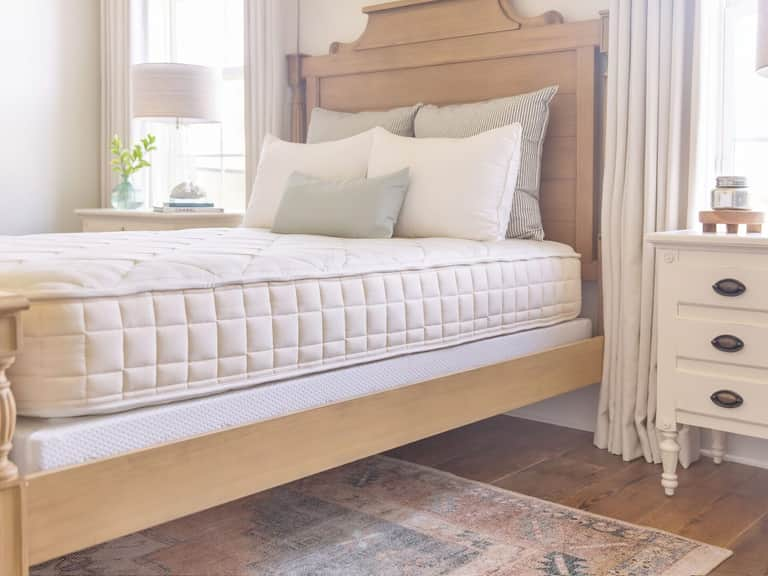
One available example is the Naturepedic Azure Hybrid Organic Mattress. Its listed construction combines six inches of wrapped coils with three inches of organic Dunlop latex in a ten-inch profile, alongside a zippered organic cotton cover and a wool, alpaca, and cashmere blend. The product information also describes dual firmness options in Queen, King, and California King sizes. Those details make it a useful illustration of how a manufacturer can specify the major components of a latex-and-coil hybrid. They do not, by themselves, establish that its feel will suit a particular sleeper; comfort remains personal, and the current configuration and documentation should be confirmed before purchase.
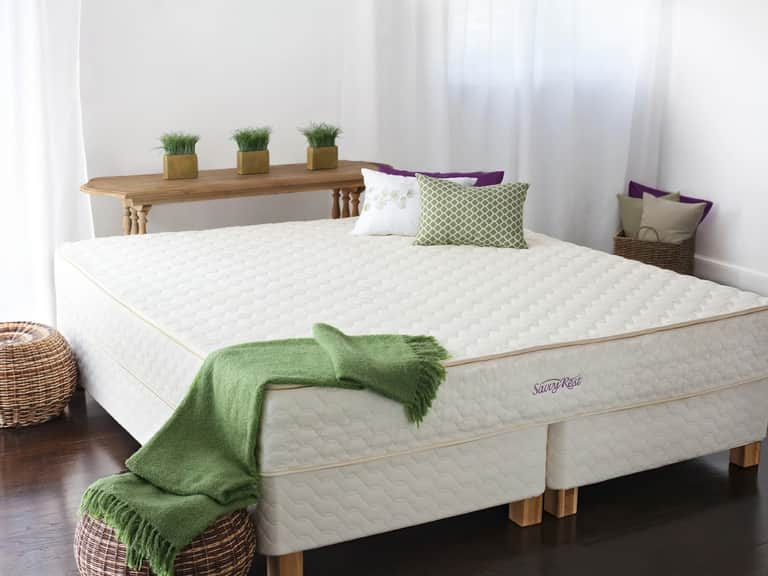
An all-latex mattress offers a helpful point of contrast. The Savvy Rest Serenity, for example, is described as a customizable three-layer latex mattress with organic wool and cotton in its casing, rather than a coil support core. Comparing it with a hybrid can clarify what the springs are contributing: a different kind of support structure and response, not a certification shortcut or an automatic upgrade.
A cover is part of the construction
The cover is sometimes treated as a decorative wrapper, but it is the material closest to the sleeper and can affect the bed’s surface feel. Cotton, wool, and other fibers may appear in the ticking or quilting. Wool is often used as a natural flame-resistant material, while cotton can provide a breathable textile surface. The specific function depends on how the layers are built and what the manufacturer documents.
Ask whether the cover is removable, whether it can be washed, and what care is permitted. A zippered cover is not necessarily designed for home laundering. Removing it may expose layers that should not be disturbed, and washing can affect the fit or warranty. If spills or allergies are a concern, a compatible protector may be more practical than assuming the mattress cover is washable.
Also look for adhesives, fire barriers, and other components that may not appear in a short product description. Some mattresses are assembled without glue; others may use adhesives in particular layers. Neither a broad “natural” description nor a fiber list tells the whole story. A component-by-component materials statement is more useful.
Certifications: what the seal does—and does not—say
Certifications can help make a complicated supply chain more legible. They are not interchangeable, and a logo is only as informative as its scope. A standard may address the agricultural origin of a fiber, the processing of a material, chemical restrictions, or a finished product’s emissions. It may apply to one component, one facility, or a whole product, depending on the scheme and the certificate. The prudent reader asks what was certified, by whom, and for which product or production site.
For latex, the Global Organic Latex Standard, commonly abbreviated GOLS, is associated with organic latex and requirements across relevant processing and chain-of-custody stages. The Global Organic Textile Standard, or GOTS, concerns organic textile processing and products within its scope. A mattress can contain latex and textiles with different certification records; one certificate should not be assumed to cover every material in the bed.
Other labels may address harmful substances or emissions rather than organic farming. They can be valuable for those questions, but they do not establish that a mattress is made entirely from organic materials. Conversely, an organic-content certification is not, on its own, proof of every possible health, comfort, or environmental claim a seller might make.
When comparing a “natural hybrid mattress” with another model, look beyond a badge reproduced on a product page. Request the certificate name and number, identify the certifying organization, and confirm that the certificate is current. Check the holder, product category, production site, and materials covered. If the seller says the finished mattress is certified, ask to see documentation that supports that exact statement. A certification logo on a page may refer to the brand, a textile, or a separate product line rather than the entire mattress.
Good documentation is specific without being theatrical. It should help answer ordinary questions: What is the latex composition? Which textiles are certified? Are the coils steel, and how are they assembled? What is used as a fire barrier? Which layers are glued, if any? A careful seller should be able to distinguish a verified fact from a general description.
A practical comparison checklist
Product pages often arrange information to make a bed sound simple. A useful comparison reverses the order: begin with the construction, then consider the claims. Keep notes on each candidate rather than relying on memory, which is famously generous to the last mattress tried.
- Map the layers. Record the thickness and position of latex, coils, quilting, wool, cotton, and any transition materials. Ask what is not identified.
- Clarify the latex. Find out whether it is natural, synthetic, or blended, and whether the product specification names the production method and source. Do not infer purity from “latex” alone.
- Understand the spring unit. Ask about wrapped or connected coils, zoning, perimeter reinforcement, and the meaning of any coil-count claim.
- Translate comfort language. Ask how firmness is measured, whether sides can differ, and what options exist for exchanges or layer changes.
- Inspect certification scope. Match each certificate to the exact materials and product. Check dates and documentation rather than relying only on a general claim.
- Read the practical terms. Compare trial periods, return costs, warranty exclusions, delivery, setup, and the required foundation. A warranty against a manufacturing defect is not a promise that the mattress will feel comfortable forever.
- Consider the whole sleep system. The bed base, protector, sheets, room climate, and partner’s preferences all affect the experience.
Support, longevity, and the frame beneath
A mattress cannot perform as intended on every surface. Follow the maker’s requirements for slat spacing, platform support, and adjustable bases. An unsuitable foundation may affect comfort and may complicate a warranty claim. If a hybrid is heavy, as many latex-and-coil builds are, confirm that the frame can support it and that delivery access is adequate.
Care is usually more prosaic than marketing language suggests. Use a protector if the manufacturer permits one, rotate the mattress only if instructed, and avoid bending or folding a coil unit unless the design explicitly allows it. Check the warranty for sagging thresholds and the conditions under which a claim is valid. A visible impression may be treated differently from ordinary softening; the precise terms matter.
Longevity is not determined by one material alone. The quality of the latex and springs, the way the layers are assembled, the base, the sleeper’s use, and the ability to maintain the bed all contribute. A seller may describe a material as durable, but a warranty and detailed construction sheet tell you more about the maker’s commitments than a general adjective can.
A quieter kind of certainty
There is a temptation, when choosing an organic mattress, to search for one perfect label that will settle the matter. But a bed is not a single claim. It is a sequence of materials, each with a job, assembled into a surface that a particular body will meet night after night. The certification can help establish what a component is and how it was handled; it cannot choose firmness for you. The coil count can describe part of the support unit; it cannot predict the feeling of the whole mattress. “Natural” may be important, but it does not replace a materials list.
The most reliable comparison therefore has a modest ambition. It seeks enough evidence to understand the construction, enough transparency to assess the claims, and enough time to determine whether the bed feels right. In that account, latex and coils are not rival technologies but complementary parts of a design—one offering resilient comfort, the other a structured spring foundation. Certifications add a paper trail to the physical object. The sleeper, as ever, supplies the final verdict.
Frequently asked questions
Is every hybrid mattress made with latex?
No. “Hybrid” generally describes a mattress combining a spring support core with foam or other comfort materials. Some use latex; others use different foams, fibers, or combinations. Check the layer list rather than assuming the term identifies a specific material.
Does a GOLS certification mean the whole mattress is organic?
Not necessarily. GOLS relates to organic latex within its certification scope. Other components—such as cotton, wool, coils, or adhesives—may have separate documentation or none. Ask which exact materials and product are covered by each certificate.
Will a latex-and-coil hybrid sleep cooler than an all-latex mattress?
It may have airflow characteristics associated with an open coil core, but no construction guarantees a cooler experience for every sleeper. Latex thickness, quilting, covers, bedding, room conditions, and personal temperature regulation all contribute.
What matters more: latex thickness or coil count?
Neither figure is meaningful in isolation. Thickness helps describe how much latex is present and where it sits; coil count is only one detail of the spring unit. Compare full layer specifications, coil design, comfort policies, and the complete certification record.